Series launch
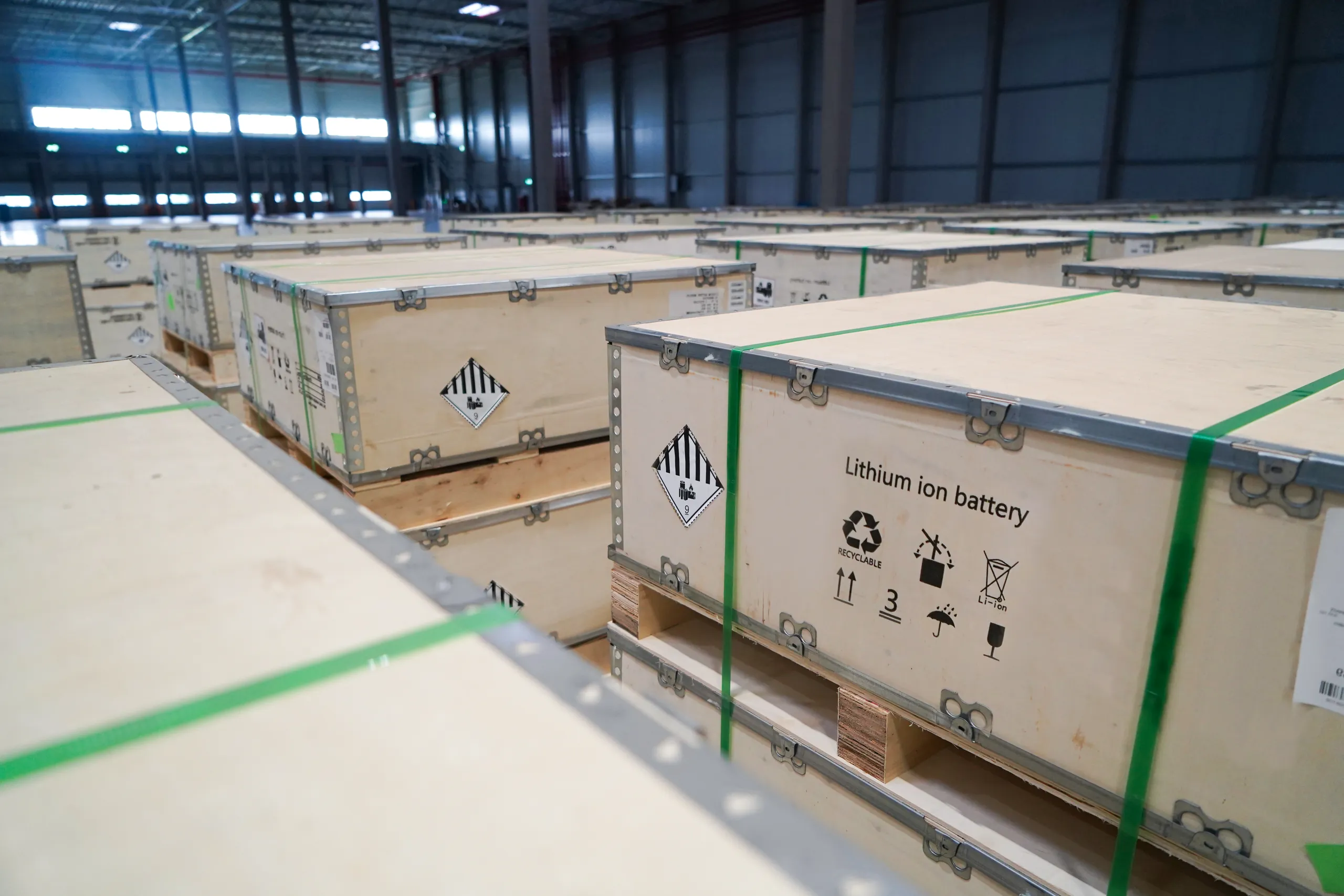
Buffer storage in the hazardous materials warehouse in Paderborn, completed in 2023/24. The batteries go to your assembly on call-off.

EV battery logistics: cells, modules and packs are buffered in Paderborn and delivered ADR-compliant to your assembly line on call-off.
The European Battery Hub (EBH) in Paderborn, Germany, handles EV battery logistics for automotive manufacturers: cells, modules and packs are buffered in a hazardous materials warehouse with 45,000 storage spaces (WGK 3, Class 9 M4) and delivered to battery assembly on call-off by ADR transport (UN 3480/UN 3481). Imported cells are cleared through our customs service.
A high-voltage battery is the drive or traction battery of an electric vehicle (EV). In vehicles, high voltage means a direct-current voltage above 60 volts; passenger car batteries usually run at around 400 or 800 volts. For transport, a lithium-ion high-voltage battery is class 9 dangerous goods, shipped on its own under UN 3480 (more on UN 3480 and UN 3481). From 18 February 2027, electric vehicle batteries also need a digital battery passport under the EU Battery Regulation.
Electrification shifts a substantial share of a vehicle's value into the high-voltage battery. Cells and modules are high-value, classified as dangerous goods and have to reach the assembly reliably, during series launch as well as in ongoing production.
Buffer storage in the hazardous materials warehouse in Paderborn, completed in 2023/24. The batteries go to your assembly on call-off.
Supply of replacement batteries. The case study below shows an example: the service network for electric industrial vehicles.
A specialized partner takes damaged or recalled batteries directly to recycling.
All of this is backed by more than 170 years of logistics experience and an ADR network that reaches more than 40 countries.
From the incoming cell to delivery at battery assembly, combined to fit your needs.
Goods receipt, visual inspection and storage of cells, modules and packs from international sourcing, ADR compliant and with a temperature check at the inbound inspection gate.
Explore battery logistics02Cells, modules and packs are buffered in the hazardous materials warehouse and delivered to your battery assembly on call-off.
See the hazardous materials warehouseDemand-based picking and dispatch preparation in line with dangerous goods rules, with documentation for every shipment.
Class 9 transport (UN 3480/UN 3481) to more than 40 countries, with trained personnel and complete documentation.
Explore dangerous goods transport05Import of cells and modules from Asia and overseas, including clearance, documentation and supply chain transparency.
Explore customs serviceCapacity that grows with your model launches and volumes, with no investment in your own hazardous materials infrastructure.
One continuous inbound process, from international goods receipt to delivery at battery assembly.
Cells, modules and packs arrive from your international supply chain. We handle customs clearance and transport to Paderborn.
At the inbound inspection gate, incoming batteries are checked by temperature check. Anomalies are spotted before goods enter the warehouse.
Goods are buffered in the hazardous materials warehouse in Paderborn, with FM Global sprinklers, temperature monitoring by the thermal imaging drone and full inventory transparency.
Called off to your production plan: we pick the goods and prepare them for transport in line with dangerous goods rules.
ADR-compliant transport to the battery assembly on the agreed date.
Automakers work under a strict quality regime, think IATF 16949, and they expect the same from their logistics partners. We support that requirement with documented processes, inspection at goods receipt and a certified management system (DIN EN ISO 9001 for quality, DIN EN ISO 14001 for the environment).
On top of this comes dangerous goods compliance: lithium-ion batteries are class 9 dangerous goods. Transport (ADR), packaging and documentation all follow the applicable standards. As a rule, every battery type must be tested to UN 38.3; exceptions apply, for example, to prototypes and small series and to defective batteries or batteries for disposal. This keeps your inbound supply chain auditable and resilient.
Which road transport rule applies depending on the condition of the battery, and what the European Battery Hub handles.
| Condition of the battery | Rule (ADR) | EBH service |
|---|---|---|
| Intact, battery type tested to UN 38.3 | Class 9 dangerous goods, on its own UN 3480 | Storage in the hazardous materials warehouse, ADR transport, customs clearance |
| Prototype or small series without UN 38.3 test | Special provision 310, packing instruction P910 | ADR transport with trained staff, more on UN 38.3 |
| Damaged or defective | Special provision 376, packing instruction P908 | Transport to recycling through a specialized partner, packaging by condition, more on defective batteries |
| Critically defective | Special provision 376, packing instruction P911 | Transport in the battery containment box with BAM specification 15854 |
How a provider of electric industrial vehicles secures supply to its service partners
For a provider of electric industrial vehicles, the European Battery Hub supplies workshops and service partners with replacement batteries and components from central stock and organizes the transport of batteries due for replacement directly to the agreed destination in an agreed process.
A provider of electric industrial vehicles has to supply its workshops and service partners reliably with replacement batteries and components. At the same time, the availability of many different items is to be managed centrally.
More predictable spare parts supply, consistent logistics processes and one central point of contact for all transport around the battery.
Want to simplify battery and spare parts logistics?Develop the right solution for your service network with the EBH.
Request a quoteTalk directly with our business development team.
We will get back to you within 24 hours on business days.

Head of Business Development

Business Development Manager

Business Development Manager
The European Battery Hub (EBH) in Paderborn, powered by Hartmann International, handles EV battery logistics for automakers: goods receipt, secure storage, ADR dangerous goods transport and customs clearance from a single source. Cells, modules and battery packs are buffered in the hazardous materials warehouse with 45,000 storage spaces and delivered to battery assembly on call-off in full ADR compliance. This frees up plant space without putting supply to assembly at risk.
Cells, modules and battery packs can be stored in our hazardous materials warehouse in Paderborn (20,300 m², 45,000 storage spaces, WGK 3 / class 9 M4) and delivered to the battery assembly on call-off. This moves inventory and floor space out of the plant and into a hub approved for dangerous goods. Storage follows dangerous goods and fire protection rules, with FM Global sprinkler protection, a fire alarm system, gas detection and a round-the-clock thermal imaging check by drone. We agree the storage model that suits your plant in a personal conversation.
Yes. The EBH hazardous materials warehouse offers 20,300 m² of space and 45,000 storage spaces and grows with model launches and rising volumes, without the automaker having to invest in its own hazardous materials infrastructure. Capacity for storage and for ADR transport to more than 40 countries can be added as needed. This keeps the inbound chain predictable even through the ramp-up curve.
Prototypes and small series whose battery type has not yet been tested to UN 38.3 may be carried under ADR special provision 310 with packing instruction P910, still as class 9 dangerous goods. We transport such development batteries in full ADR compliance with trained personnel. The UN 38.3 page explains the test scope and exceptions.
Read more: UN 38.3 explained
At the inbound inspection gate (WE-Gate) we check incoming batteries by temperature check before they go into storage, and inside the warehouse a thermal imaging drone checks the stock around the clock with thermal imaging. Processes are documented, and we operate a certified management system to DIN EN ISO 9001 (quality) and DIN EN ISO 14001 (environment). Which requirements from the IATF 16949 environment of your plant we cover is agreed in the project.
In a recall, we arrange through a specialized partner the collection of the affected battery packs from plants, workshops and service partners and their transport directly to recycling; they do not come to Paderborn. Damaged batteries are handled under ADR special provision 376, and critically defective ones travel in the battery containment box with BAM specification 15854. We arrange the transport of damaged or defective packs through a specialized partner, which also covers the waste-law side with its permit for waste transport.
A damaged or defective high-voltage battery falls under ADR special provision 376 and is packed to packing instruction P908; if it can react dangerously (critically defective), P911 applies. Damaged batteries must not be carried by air. The European Battery Hub arranges the collection of such batteries from plants, workshops and service partners through a specialized partner and uses the battery containment box with BAM specification 15854 for critically defective batteries.
Read more: Defective batteries (DDLB), Battery containment box
Talk to our team about buffer storage, ADR transport and import handling for your OEM supply chain. We will develop a concept that fits your volumes. We respond within 24 hours on business days.