
Marcel Niebuhr
Head of Business Development

How an emergency response plan for lithium-ion batteries is structured and how the European Battery Hub responds in an emergency.
A lithium battery emergency response plan defines in advance how a thermally abnormal or critically defective battery is detected, extinguished, isolated and removed. At the European Battery Hub (EBH) in Paderborn, Germany, four stages interlock: early detection at the inbound inspection gate and by thermal imaging drone, fire suppression with FM Global sprinklers, quarantine in the containment box with BAM specification 15854, and ADR-compliant removal.
Lithium-ion batteries store a lot of energy, and that is exactly what makes them demanding when something goes wrong. A mechanically damaged, overcharged or faulty cell can heat itself up and trigger thermal runaway: a self-accelerating chain reaction with intense heat, gas and smoke. Water cools and stops the spread, but it does not reliably end the reaction in the affected cell. The rule is therefore: cool and isolate the battery.
In an emergency there is no time to improvise. The EBH emergency response plan therefore sets responsibilities, trained staff, technology and procedures in advance, so that an incident stays confined to the affected battery. It is built on the hazardous materials warehouse in Paderborn, designed for WGK 3 and Class 9 (M4), with the three-stage fire protection described in how to store lithium batteries safely.
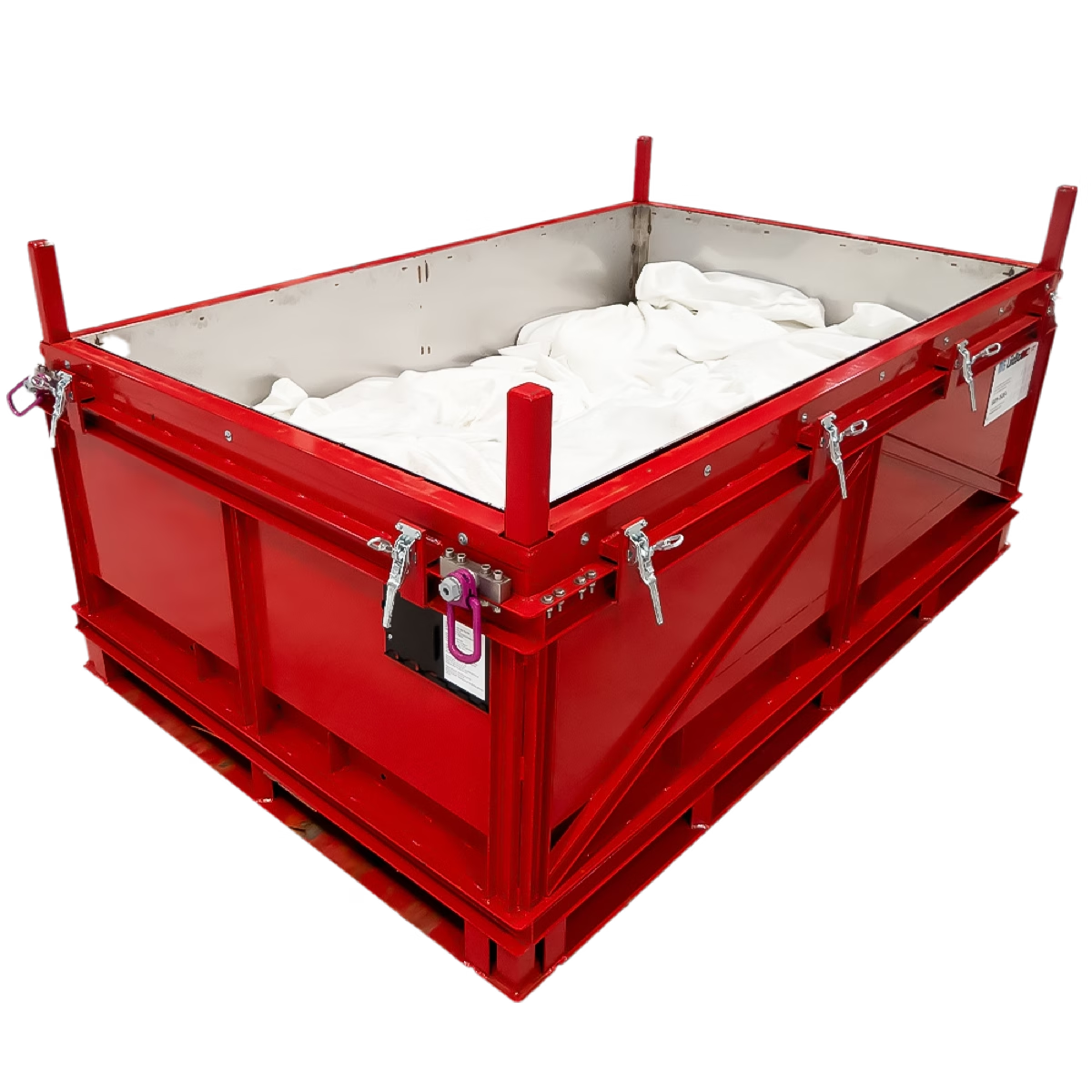
Critically damaged lithium-ion batteries must be isolated immediately. For this the European Battery Hub uses the containment box, the Liio-Box. It is covered by BAM specification 15854, withstands up to 1,240 °C inside and reaches no more than 52 °C outside. A stainless-steel sump catches escaping electrolyte, and the box is latched on all sides, lockable, forklift-accessible and stackable. In this way the critical battery stays safely enclosed, on site in an emergency and on the road. All specifications are on the containment box page.
Also in preparation is a permanently installed emergency container outside the warehouse, with its own extinguishing system and a firewater retention basin. In an emergency, conspicuous goods can be isolated there and extinguished directly. The container is currently in the planning and permit phase.
From the first heat signal to removal, a defined four-stage process interlocks.
The inbound inspection gate checks deliveries for temperature and condition (goods too large for the gate go through their own goods receipt processes), the thermal imaging drone checks the warehouse around the clock with thermal imaging, and a fire alarm system and gas detection monitor the warehouse as well. The aim is to detect a cell that is heating up before it escalates.
In the event of a fire, the FM Global sprinkler system extinguishes it. A fire water tank holding around 1 million liters supplies the sprinkler system. Contaminated fire water stays inside the hall: the floors are sealed, and a fire water barrier is added.
The affected battery is transferred into the containment box (Liio-Box). The box withstands up to 1,240 °C inside and stays at no more than 52 °C outside, so the critical battery is isolated in space.
In the sealed, ADR-compliant box, the defective battery is transported for proper treatment or to a recycling plant. We arrange this transport, fully documented, through a specialized partner.
Technology only works when organization and building match it. At the EBH, lithium batteries are stored in a hazardous materials warehouse with a fire alarm system, gas detection, a round-the-clock thermal imaging check by drone and an FM Global sprinkler system. Structural, technical and organizational fire protection are coordinated:
Safe packaging of damaged and defective batteries to P908 and P911, with transport through a specialized partner.
See defective batteries (DDLB)The round-the-clock thermal imaging check makes thermal anomalies visible at an early stage.
See the thermal imaging droneADR-compliant Class 9 transport to more than 40 countries.
See dangerous goods transportTalk directly with our business development team.
We will get back to you within 24 hours on business days.
Head of Business Development

Business Development Manager

Business Development Manager
An emergency response plan defines in advance how a thermally abnormal or critically defective lithium-ion battery is handled: early detection, fire suppression, isolation and safe removal. At the European Battery Hub it covers the inbound inspection gate, the thermal imaging drone, a fire alarm system and gas detection, an FM Global sprinkler system, quarantine in the containment box and ADR-compliant removal, backed by trained staff, regular emergency drills, clear responsibilities and traceable documentation.
The inbound inspection gate checks deliveries for temperature, in the warehouse a thermal imaging drone checks the batteries around the clock with thermal imaging, and a fire alarm system and gas detection monitor the warehouse. In an emergency, the FM Global sprinkler system extinguishes the fire, and the battery is isolated in the containment box. How thermal runaway develops and why water does not reliably stop it is explained in our guide.
Read more: Thermal runaway: causes, phases and extinguishing
The hazardous materials warehouse of the European Battery Hub has an FM Global sprinkler system for hazardous materials, a fire water tank holding around 1 million liters for the sprinkler system, and sealed hall floors and a fire water barrier that hold back contaminated fire water. In addition, there are the temperature check at the inbound inspection gate, a fire alarm system, gas detection and the round-the-clock thermal imaging check by drone.
Read more: How to store lithium batteries safely
A critically defective battery is first isolated in the containment box, a Liio-Box with BAM specification 15854 that withstands up to 1,240 °C inside and reaches no more than 52 °C outside. In the sealed box, it is shipped as Class 9 dangerous goods for proper treatment or recycling. We arrange collection and transport through a specialized partner, and the entire route is documented.
Read more: Battery containment box (Liio-Box)
Yes. You have one point of contact at the European Battery Hub, and we arrange the collection and transport of damaged or defective batteries through a specialized partner. Our partner moves critically defective batteries in special transport boxes. Its drivers are specifically trained to handle used and damaged batteries, and the truck carries the right emergency equipment. Because defective batteries are often classed as waste, the partner holds the permit for waste transport and has a connected recycling and disposal network. Damaged and defective batteries go straight to the recycler, not to Paderborn, and we do not store them. We agree the procedure, packaging and date with you case by case.
Read more: Shipping damaged lithium batteries
In Germany, no single law requires one. What counts is the state of the art, the risk assessment, the hazardous substance rules of TRGS 510 and the rules of property insurers, above all the VdS 3103 information sheet. A robust emergency response plan with early detection, fire suppression, containment and quarantine is therefore usually a precondition for a battery warehouse to be insurable.
Read more: Insurable battery warehouse
We discuss the right emergency response plan with you, the use of the containment box and the link to storage and transport. Call +49 5251 7207-815 or email info@european-battery-hub.com. We respond within 24 hours on business days.