
Marcel Niebuhr
Head of Business Development

Heavy haulage for battery storage from rack to container: with permit, route and loading as Class 9 dangerous goods.
Heavy haulage for battery energy storage is the permit-based transport of large battery energy storage systems, such as BESS containers, that may not travel in regular traffic because of their weight or dimensions. The European Battery Hub (EBH) in Paderborn handles the feasibility study, route survey and permit, coordinates partners and individual trades, loads with its own equipment and carries the system as Class 9 dangerous goods.
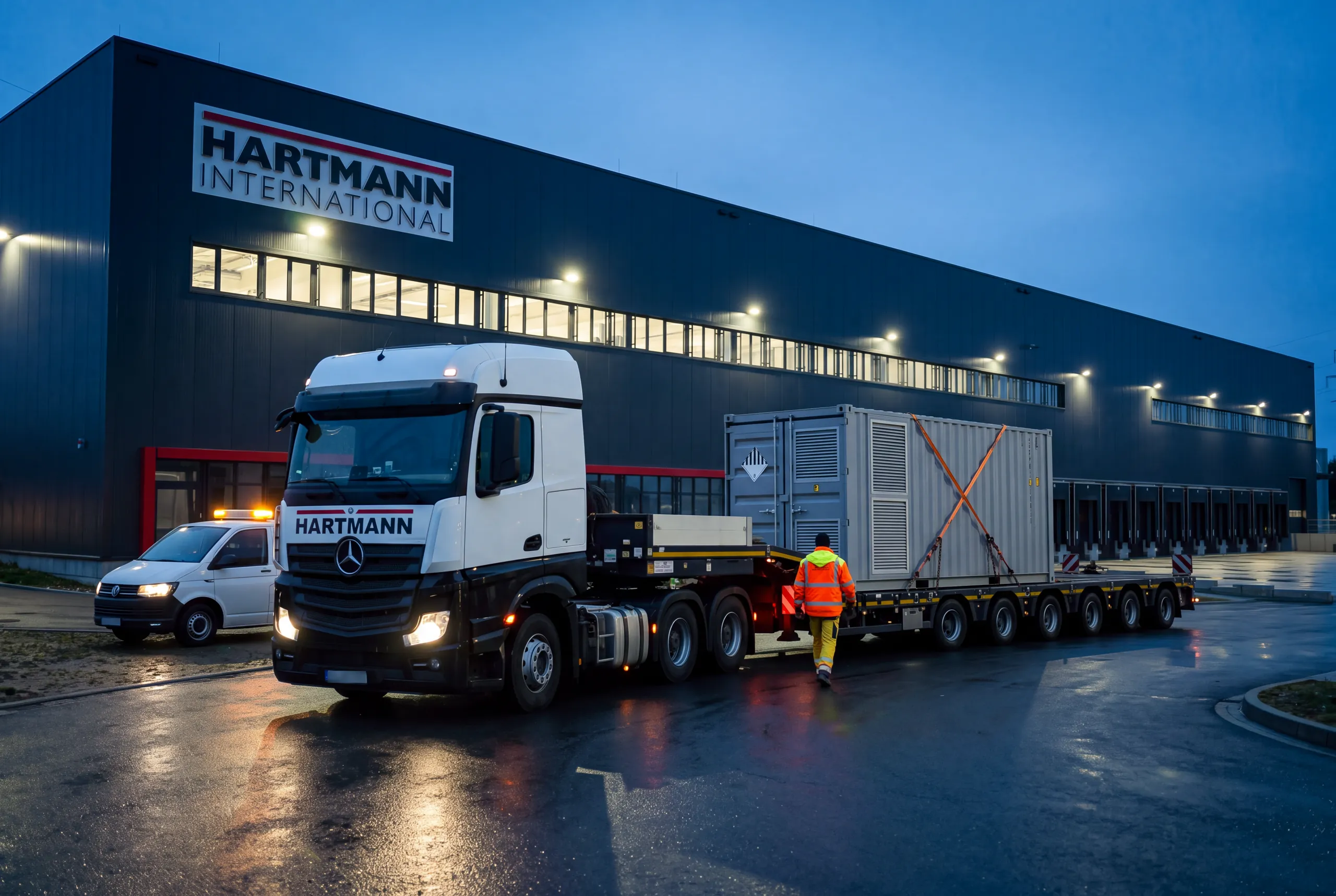
Whether a battery storage system may travel in regular traffic or needs heavy haulage depends on its weight and dimensions. Once a vehicle and its load exceed the general limits, typically 2.55 m width, 4.00 m height, 16.50 m length for an articulated vehicle and 40 t gross weight, the transport needs a permit in Germany under Section 29(3) StVO and usually an exemption under Section 46 StVO. A large battery storage system is therefore treated like a machinery transport: weight and dimensions decide on the permit, not the type of load.
Large battery energy storage systems reach this threshold quickly. A BESS container combines many lithium-ion modules in a 20 or 40 foot housing and is correspondingly heavy. Individual modules and packs can often still travel as groupage via our battery freight forwarding; battery racks and part containers sit in the borderline range; containerized large-scale storage systems regularly need heavy haulage. We clarify in advance which transport type applies to your system, based on weight, dimensions and destination.
The European Battery Hub specializes in battery storage systems. Heavy haulage for machinery, plant and other loads without batteries is handled by the freight forwarding division of Hartmann International: heavy haulage at Hartmann International (page in German).
How heavy haulage for a battery storage system is prepared and approved. Lead time depends on the route, the dimensions and the German federal states involved and is often several weeks.
We check dimensions, weight and destination, prepare a feasibility study where needed and survey the route for bridges, clearance heights and bottlenecks.
The permit under Section 29(3) StVO and the exemption under Section 46 StVO are applied for via VEMAGS, Germany's nationwide online procedure for oversize and heavy transport. The vehicle may also need an exemption under Section 70 StVZO.
The authorities involved review the route and set conditions, such as time windows, escort vehicles or a police escort.
The transport travels on the approved route within the set time window; we coordinate escort vehicles and partners.
Loading with verified load securing, heavy-lift handling with our own equipment and a documented handover at the destination.
In heavy haulage for a battery storage system, permits, loading and dangerous goods law interlock. The European Battery Hub plans and coordinates the entire process, backed by the ADR experience of its battery logistics.
Point to or tap a number in the image for details.
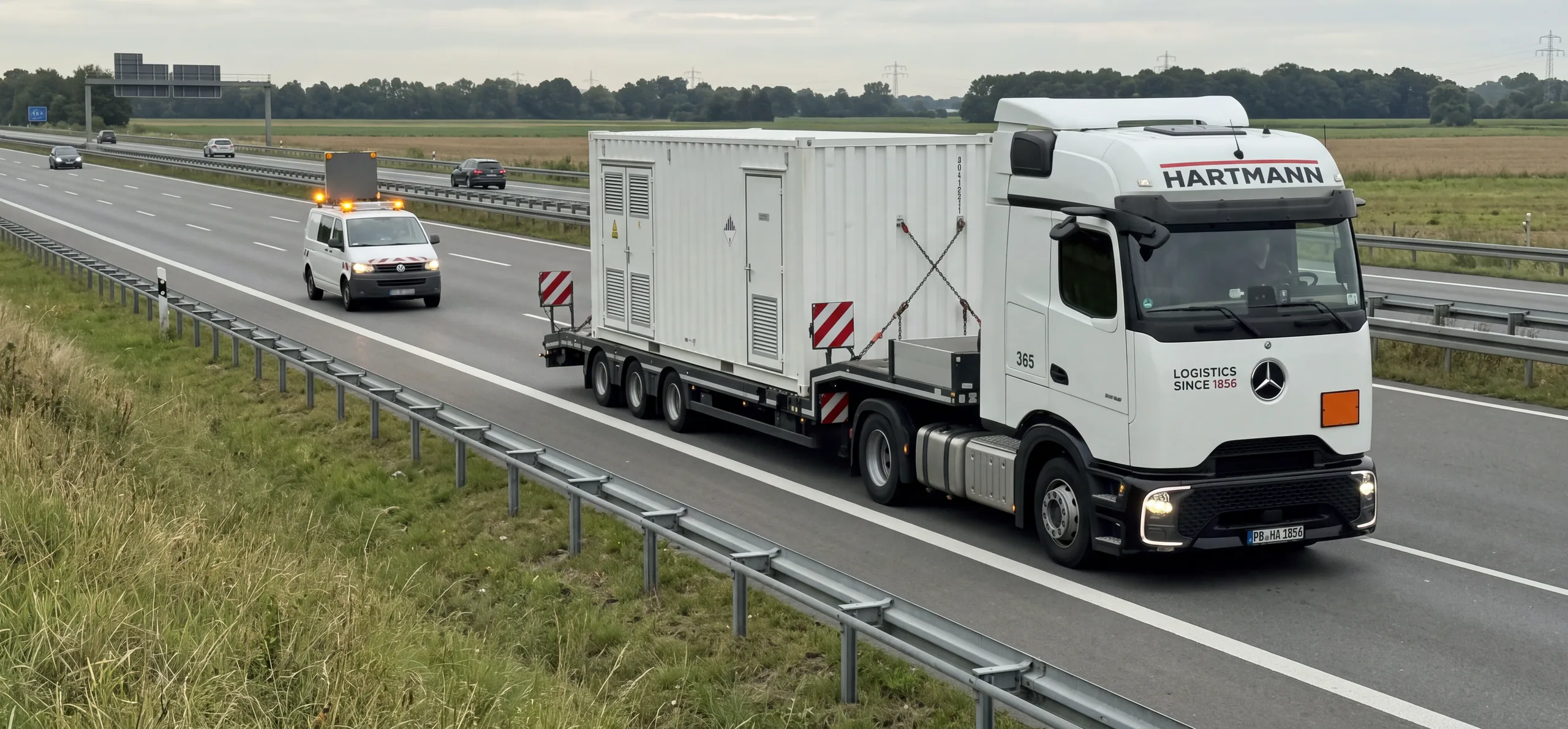
Selection of the right means of transport, from low-loaders through semi and modular low-loaders to platform and flat-rack solutions for BESS containers, racks and large modules; we coordinate partners and individual trades for this.
Obtaining the heavy haulage permit from the relevant authorities as part of transport preparation, including the necessary evidence and deadlines.
Feasibility study and route survey for bridges, clearance heights and bottlenecks; we organize coordination with the authorities and, where required, the police.
Organization of escort vehicles (BF2/BF3) and safeguarding of the journey along the approved route.
Heavy-lift handling with our own equipment and trained staff, from a single module to a complete storage system; verified load securing and safe handling at loading and handover.
ADR-compliant carriage, labeling and vehicle equipment for UN 3480, UN 3481 and UN 3536, in one process rather than separately; classification and transport documents remain with the consignor.
Even as heavy haulage, a battery storage system remains dangerous goods: lithium-ion batteries belong to dangerous goods Class 9 (M4), with UN 3480 (batteries shipped on their own) and UN 3481 (in or with equipment); batteries installed in a container or other cargo transport unit usually ship as UN 3536. Transport, labeling and documents follow ADR. The European Battery Hub handles dangerous goods transport to more than 40 countries; the consignor classifies every unit according to its design.
Moving large storage systems comes down to loading: verified load securing, heavy-lift handling with our own equipment and complete documentation up to delivery. If a system has to be stored before or after transport, racks and modules stay in the EBH hazardous materials warehouse in Paderborn, covered by the emergency response plan; complete containers are stored on our storage site in Rheda-Wiedenbrück because of their dimensions and weight.
Packaging, interim storage and delivery of containerized systems are described on BESS container transport and storage, the requirements of the sector on logistics for grid-scale battery storage. Several transports for one storage project, with interim storage and delivery in the site time window, are planned as project logistics for battery systems.
How a battery storage system is transported depends mainly on its size and weight. The overview below sorts the typical cases; we define the specific transport type based on your system data.
| Storage size | Typical carriage | Particular feature |
|---|---|---|
| Cells, modules, smaller packs | Groupage or part load via battery freight forwarding (CargoLine) | Dangerous goods Class 9 (UN 3480/3481), usually regular traffic |
| Battery racks, part containers | Part load or full load | Heavy-lift handling possible depending on weight and dimensions |
| Containerized large-scale storage / BESS (20 or 40 foot) | Heavy haulage (oversize and/or overweight) | May require a permit (Sections 29 and 46 StVO); Class 9 dangerous goods, installed batteries usually UN 3536 |
| End-of-life storage systems | ADR transport directly to reuse or recycling | Transport through a specialized partner with a permit for waste transport |
There is no flat rate. The price depends mainly on the dimensions and weight of the storage system, the route and distance, permit fees, escort vehicles or a police escort, crane and handling services, possible waiting times due to time windows, and the Class 9 dangerous goods requirements.
The earlier we know the weight, dimensions, destination and date, the more precisely the transport can be planned. We prepare each quote individually and respond to your inquiry within 24 hours on business days.
Reply within 24 hours on business days
Large storage systems remain dangerous goods of Class 9 (UN 3480, UN 3481 or UN 3536). Transport, labeling and documentation follow ADR, with our own ADR fleet and trained staff.
To dangerous goods transportWe organize the heavy haulage permit (Sections 29 and 46 StVO), route survey and escort vehicles for you, including coordination with the authorities.
Request transportHeavy-lift handling with our own equipment, verified load securing and complete documentation from goods-in to delivery.
To BESS logisticsHeavy haulage, storage in the hazardous materials warehouse and the emergency response plan come from one team, instead of several providers coordinated separately.
See the emergency response planTalk directly with our business development team.
We will get back to you within 24 hours on business days.
Head of Business Development

Business Development Manager

Business Development Manager
Weight and dimensions decide. Once a vehicle and its load exceed the general limits on public roads, typically 2.55 meters width, 4.00 meters height and 40 tonnes gross weight, the transport counts as heavy haulage and needs a permit in Germany under Sections 29 and 46 StVO. Individual modules and packs can often still travel in regular traffic, whereas containerized large-scale storage systems regularly exceed this threshold.
Yes. Permits, route surveys and feasibility studies are part of our transport preparation. We obtain the permit under Sections 29 and 46 StVO from the relevant authorities, survey the route for bridges and clearance heights and, where required, organize coordination with the police. You do not have to deal with the authorities yourself.
Yes. For transporting large battery storage systems we select the right specialized equipment, from low-loaders through semi and modular low-loaders to platform and flat-rack solutions, and organize the necessary escort vehicles (BF2/BF3) to safeguard the journey along the approved route. For this we coordinate partners and individual trades. We handle heavy-lift transshipment with our own equipment and trained staff, from a single module to a complete storage system.
There is no flat rate. Costs depend mainly on the dimensions and weight of the storage system, the route, permit fees, escort vehicles or a police escort, crane and handling services, waiting times and the Class 9 dangerous goods requirements. We calculate every transport individually and respond to your inquiry within 24 hours on business days.
That depends on the route, dimensions, weight and the number of German federal states involved. Applications are made via VEMAGS, the nationwide online procedure; expect a lead time of several weeks. That is why the feasibility study and route survey come at the start of our planning.
Lithium-ion battery storage systems are dangerous goods of Class 9 (M4). Batteries shipped on their own fall under UN 3480, batteries in or with equipment under UN 3481, and batteries installed in a cargo transport unit such as a container usually under UN 3536. Transport, labeling, documentation and vehicle equipment follow the ADR. The European Battery Hub carries batteries as dangerous goods to more than 40 countries; the consignor classifies every unit according to its design.
Read more: Battery storage containers
Yes. We arrange the collection and transport of end-of-life or defective storage systems in compliance with ADR through a specialized partner with a permit for waste transport, directly into a second life or into proper recycling.
Read more: Battery reverse logistics and second life
The European Battery Hub specializes in battery storage systems and Class 9 dangerous goods. Heavy haulage for machinery, plant, components and other loads without batteries is handled by the freight forwarding division of Hartmann International. The EBH is powered by Hartmann International, and both are based in Paderborn.
Read more: Heavy haulage at Hartmann International (in German)
Whether a battery rack or a containerized large-scale storage system, tell us the weight, dimensions and destination, and the European Battery Hub team will plan the permit, route and transport. We respond within 24 hours on business days.