
Marcel Niebuhr
Head of Business Development

We transport BESS containers as Class 9 dangerous goods, from a single rack to a 40-foot container.
BESS containers are large battery energy storage systems built from many lithium-ion modules in a 10, 20 or 40-foot housing. They are heavy and Class 9 dangerous goods, usually UN 3536 when installed in the container. The European Battery Hub (EBH) in Paderborn handles dangerous goods transport, heavy-lift handling and interim storage from a single source: racks and modules in its hazardous materials warehouse, complete containers on our storage site in Rheda-Wiedenbrück because of their dimensions and weight.
Transport: carriage as Class 9 dangerous goods (UN 3480/3481, UN 3536 when installed in a container): modules and racks as groupage via CargoLine, containers as heavy haulage, internationally via air, sea and rail; heavy-lift handling with our own equipment, from a single module to a complete storage system.
Storage: racks, modules and smaller storage systems in the hazardous materials warehouse (WGK 3, Class 9, M4) with FM Global sprinklers, fire water retention inside the hall, a fire alarm system, gas detection and a round-the-clock thermal imaging check by drone; complete containers on our storage site in Rheda-Wiedenbrück. We do not store damaged units; for emergencies, the emergency response plan applies. A defective or overheated module can enter thermal runaway, so monitoring matters along the entire route.
Handling and proof: temperature check at the inbound inspection gate, defined states of charge and complete documentation, which also eases the insurability of your goods. At end of life, we arrange transport into a second life or to recycling through a specialized partner, without bringing modules back to Paderborn; the obligations of the EU Battery Regulation and battery passport also apply to stationary storage systems.
BESS containers usually come in the standard sizes of 10, 20 or 40 feet. Because they bundle many lithium-ion modules, they are heavy and often need heavy haulage for battery energy storage: whether a permit is needed depends on the weight and dimensions of vehicle and load, not on the type of load.
Under dangerous goods law, batteries installed in a container are usually shipped as UN 3536, Class 9. For transport and storage, a defined state of charge in line with the requirements of the manufacturer and the transport route also matters. On site you need an access road with sufficient load-bearing capacity and a crane that can handle the weight and reach; both should be clarified before transport. If the site is not yet ready, racks, modules and smaller storage systems can be held at the European Battery Hub in the meantime, as in a project with 420 battery storage units; complete containers are then kept on our storage site in Rheda-Wiedenbrück.
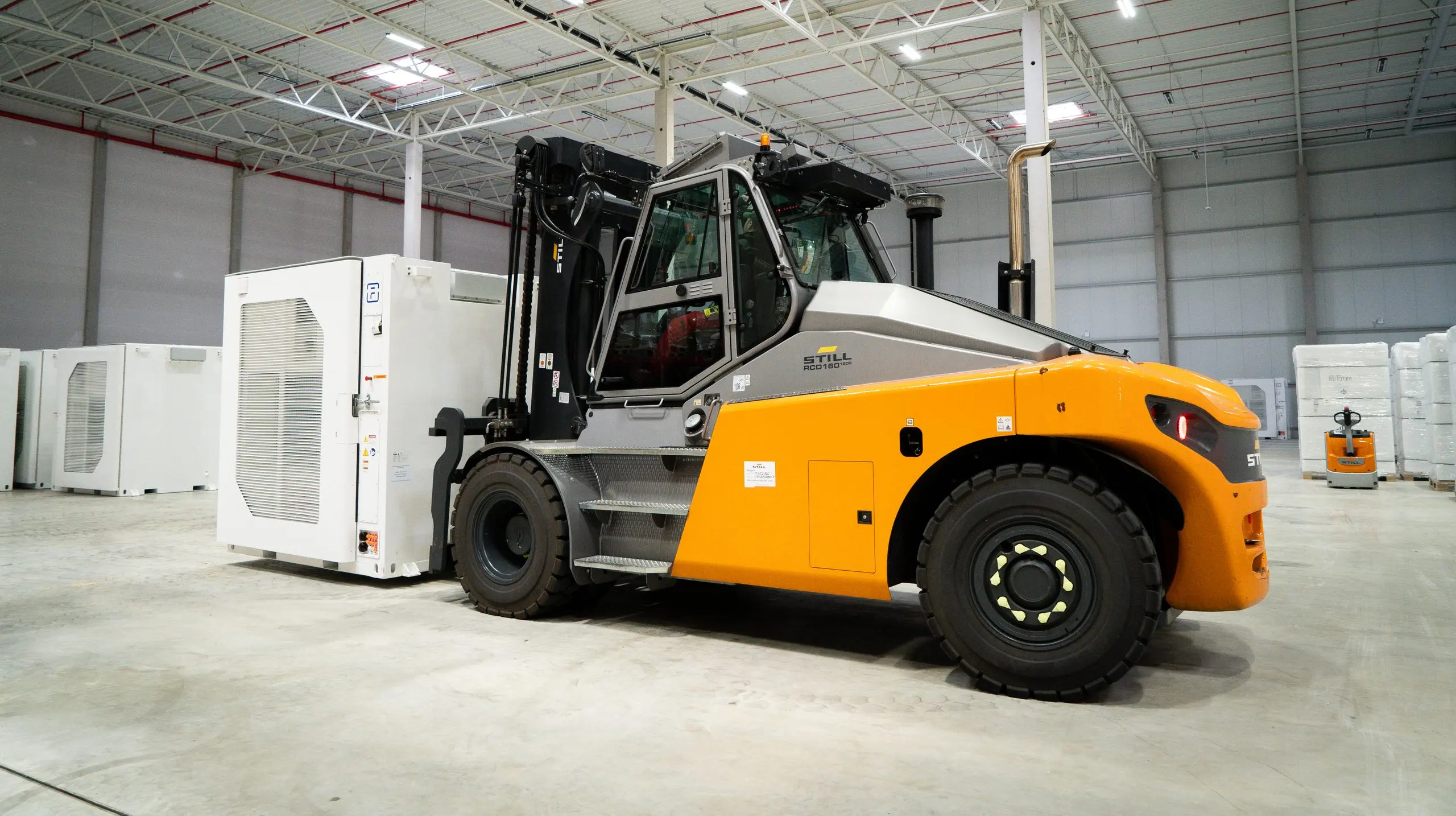
A customer needed secure storage at short notice for 420 battery storage systems weighing 8.5 tonnes each. We coordinated 210 truckloads, handled every system with our heavy-duty forklift and stored them all in Terminal 3 of the European Battery Hub.

Customer project from 2025
The European Battery Hub stored 420 battery storage systems weighing 8.5 tonnes each for a customer within two months and coordinated 210 truckloads to do so.
A customer needed secure storage at short notice for 420 battery storage systems weighing 8.5 tonnes each. High unit weights, safety requirements and a tight schedule made the project demanding.
Within two months, all 420 battery storage systems were stored safely, smoothly and on schedule.
Planning a similar project?Talk to us about quantities, weights and schedule.
Request a quoteTalk directly with our business development team.
We will get back to you within 24 hours on business days.
Head of Business Development

Business Development Manager

Business Development Manager
BESS containers are heavy, high in energy and Class 9 dangerous goods, so transport and storage need ADR compliance and fire protection. The European Battery Hub handles transport, storage and the emergency response plan from a single source: modules and racks travel as groupage via CargoLine and are stored in the hazardous materials warehouse, containers travel as heavy haulage and are stored on our storage site in Rheda-Wiedenbrück because of their dimensions and weight, and international shipments go via air, sea and rail.
Read more: Heavy transport for battery storage systems
Battery storage systems belong to dangerous goods class 9 (M4). Systems installed in a container or other cargo transport unit usually ship as UN 3536, lithium-ion batteries shipped on their own as UN 3480, and batteries in or packed with equipment as UN 3481. The consignor classifies every unit according to its design; we document classification and state of charge for transport and storage.
Read more: UN 3480 and UN 3481 in detail
That depends on dimensions and weight. Container-based and rack-based storage systems often exceed the limits of regular road traffic, and then a permit for oversize and heavy transport is required. We coordinate the permit, route planning and ADR requirements in a single process, together with heavy-lift handling.
Read more: Heavy transport for battery storage systems
Yes, racks, modules and smaller battery storage systems can be held in the European Battery Hub's hazardous materials warehouse, for example until the site is ready. In one customer project we stored 420 battery storage units weighing 8.5 tonnes each and coordinated 210 truckloads for this. Complete 20 or 40-foot containers are too large and too heavy for this; they are stored on our storage site in Rheda-Wiedenbrück. Whether and how your storage system can be stored is something we clarify based on dimensions, weight and condition.
A defective or overheated module can enter thermal runaway. In the hazardous materials warehouse (WGK 3, Class 9 M4) we therefore rely on a temperature check at the inbound inspection gate, a fire alarm system, gas detection, a round-the-clock thermal imaging check by drone, FM Global sprinklers and fire water retention inside the hall. We do not store damaged units; for them, the battery containment box with BAM specification 15854 is available.
Read more: Thermal runaway, Emergency response plan
As transport, yes. We do not store used or decommissioned modules in Paderborn or bring them back there. We arrange collection and transport directly into a second life or proper recycling through a specialized partner whose waste transport permit also covers the waste-law side.
Read more: Battery reverse logistics and second life, EU Battery Regulation and battery passport
Whether it is a single battery rack or a BESS container, the European Battery Hub team plans the transport and storage of your BESS. Call +49 5251 7207-815 or email info@european-battery-hub.com. We respond within 24 hours on business days.