
Marcel Niebuhr
Head of Business Development

Special transport for large battery storage systems: we plan transports, handling and interim storage from several suppliers as one project.
Project logistics and special transport for battery systems combine several transports, handling, interim storage, customs and Class 9 dangerous goods into one planned process, for example when many battery storage units must arrive for one site date. The European Battery Hub (EBH) in Paderborn, powered by Hartmann International, coordinates partners and individual trades and, if required, provides interim storage for racks, modules and smaller storage systems in its own hazardous materials warehouse, and for complete containers on the Hartmann storage site in Rheda-Wiedenbrück.
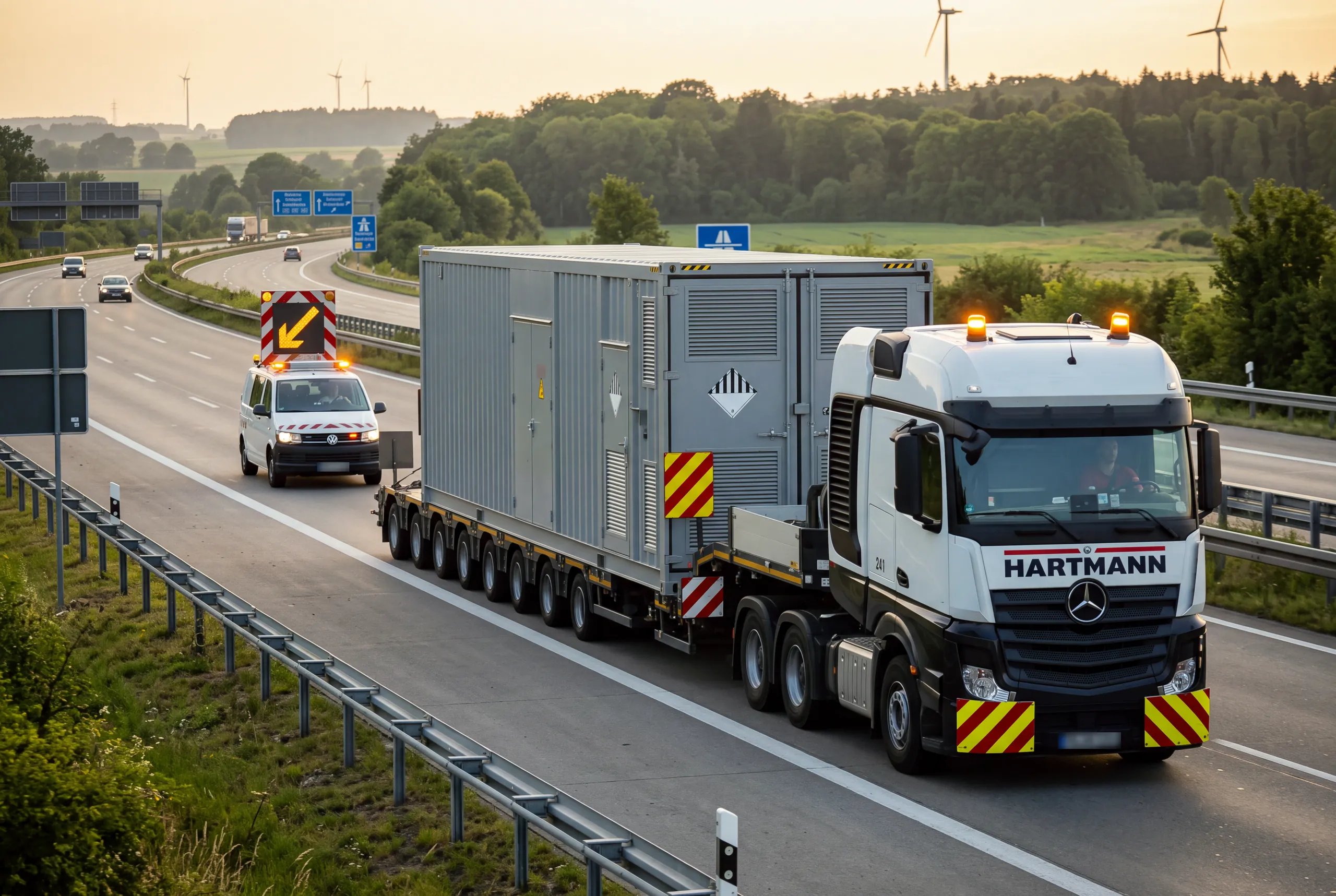
Not every battery shipment needs a project. Individual modules, packs and smaller deliveries travel as groupage or part loads via our battery freight forwarding. A single BESS container that needs a permit because of its weight or dimensions is a case for heavy haulage for battery energy storage. A delivery becomes project logistics as soon as several transports, suppliers, trades and dates depend on each other.
Typical triggers are storage projects with many heavy units in a short time, components from several suppliers for a fixed site date, imports with customs clearance and interim storage before distribution, and projects that combine road, sea and rail. One example is a large-scale storage project with 420 battery storage units, for which the EBH coordinated 210 truckloads.
A battery storage project consists of building blocks that interlock in time. The European Battery Hub plans them as one process, with one contact for the whole chain.
Planning the overall process including a feasibility study, coordinating partners, individual trades, time windows and interfaces. Hartmann International dispatches 400 vehicles per day.
Customs clearance for import and export, plus seamless documentation across the entire chain.
Combination of road, sea, rail and air via the seaports of Antwerp, Rotterdam, Amsterdam and Hamburg and the inland and rail hub of Duisburg, aligned with the project.
ADR-compliant handling and labeling for UN 3480 and UN 3481, UN 3536 for storage systems installed in a container; classification and transport documents remain with the consignor. Dangerous goods transport to more than 40 countries.
Interim storage at the EBH, bundling of components from several suppliers per project and scheduled delivery, plus value added services such as packaging and assembly.
Handling with our own equipment and trained staff, from a single module to a complete storage system, with verified load securing.
Carriage of large, heavy and bulky system components with suitable specialized equipment, including route survey and permits; details under heavy haulage for battery energy storage.
Main phaseongoingHandlingClick a name for details
Within a project, a battery system remains Class 9 dangerous goods (M4): batteries shipped on their own as UN 3480, batteries in or with equipment as UN 3481, and systems installed in a container usually as UN 3536. The consignor is responsible for classifying every unit according to its design and for the transport documents; the European Battery Hub can take care of marking under ADR. More on dangerous goods transport for lithium batteries.
In a project, handling, interim storage and transports have to fit together. Racks and modules can stay in the hazardous materials warehouse in Paderborn before delivery, and complete BESS containers on the Hartmann storage site in Rheda-Wiedenbrück because of their dimensions and weight, as described under BESS container transport and storage. For cross-border projects, the EBH handles import and export through its customs service.
Five steps we go through for every battery storage project.
We clarify quantities, dimensions, weights, battery type and target dates and check in a feasibility study which transports and storage areas are needed.
We define transport modes, vehicles and time windows, survey the routes and apply for the permits for oversize and heavy transports.
Components from several suppliers arrive at the European Battery Hub in Paderborn, are recorded and stored until called off.
Transports run in an agreed sequence, as groupage, full load or heavy haulage, with heavy-lift handling by our own equipment.
Delivery within the site time window and documented handover; dangerous goods and customs papers are part of the project documentation.
Talk directly with our business development team.
We will get back to you within 24 hours on business days.
Head of Business Development

Business Development Manager

Business Development Manager
Project logistics for battery systems is transport planned as a project because its scope, weight, dimensions or dangerous goods requirements rule out standard groupage. Typical cases are storage projects with many heavy units or components from several suppliers for one site date. The European Battery Hub plans transports, heavy-lift handling, interim storage, customs and Class 9 dangerous goods as one process.
Heavy haulage is the permit-based transport of a single large, heavy object, such as a BESS container. Project logistics is the umbrella above it: it links several transports, suppliers, trades and transport modes into one planned process, for example when many battery storage units are delivered for a storage park. Permits, limits and costs of a single transport are explained on the heavy haulage page.
Read more: Heavy haulage for battery energy storage
Yes. For one large-scale storage project, for example, the European Battery Hub stored 420 battery storage units weighing 8.5 tonnes each, coordinated 210 truckloads for this and handled transshipment with its own heavy-duty forklift. For a provider of stationary energy storage systems we bundle components from several suppliers, store the batteries in the interim and deliver per project on the agreed date. We define the specific project scope based on your system data.
Read more: View case studies
In addition to road transport, the European Battery Hub combines sea, rail and air (air/sea/rail) as needed via the seaports of Antwerp, Rotterdam, Amsterdam and Hamburg and the inland port and rail hub of Duisburg. This also covers international projects and the import of battery systems. Which combination makes sense depends on weight, dimensions, destination and schedule.
There is no flat rate. Costs depend on the number, dimensions and weight of the units, route and transport modes, permits and escorts, handling, length of interim storage, customs and the Class 9 dangerous goods requirements. We calculate every project individually and respond to your inquiry within 24 hours on business days.
As early as possible, ideally once quantities, dimensions, weights and the site date are known. Permits for oversize and heavy transports often need several weeks of lead time, and vehicles and interim storage space are easier to plan with notice. We can give a first assessment based on preliminary data.
Whether a storage project with many units, components from several suppliers or a bulky special transport, tell us the scope, weight, dimensions and destination, and the European Battery Hub team plans transport, handling and dangerous goods as one project. We respond within 24 hours on business days.